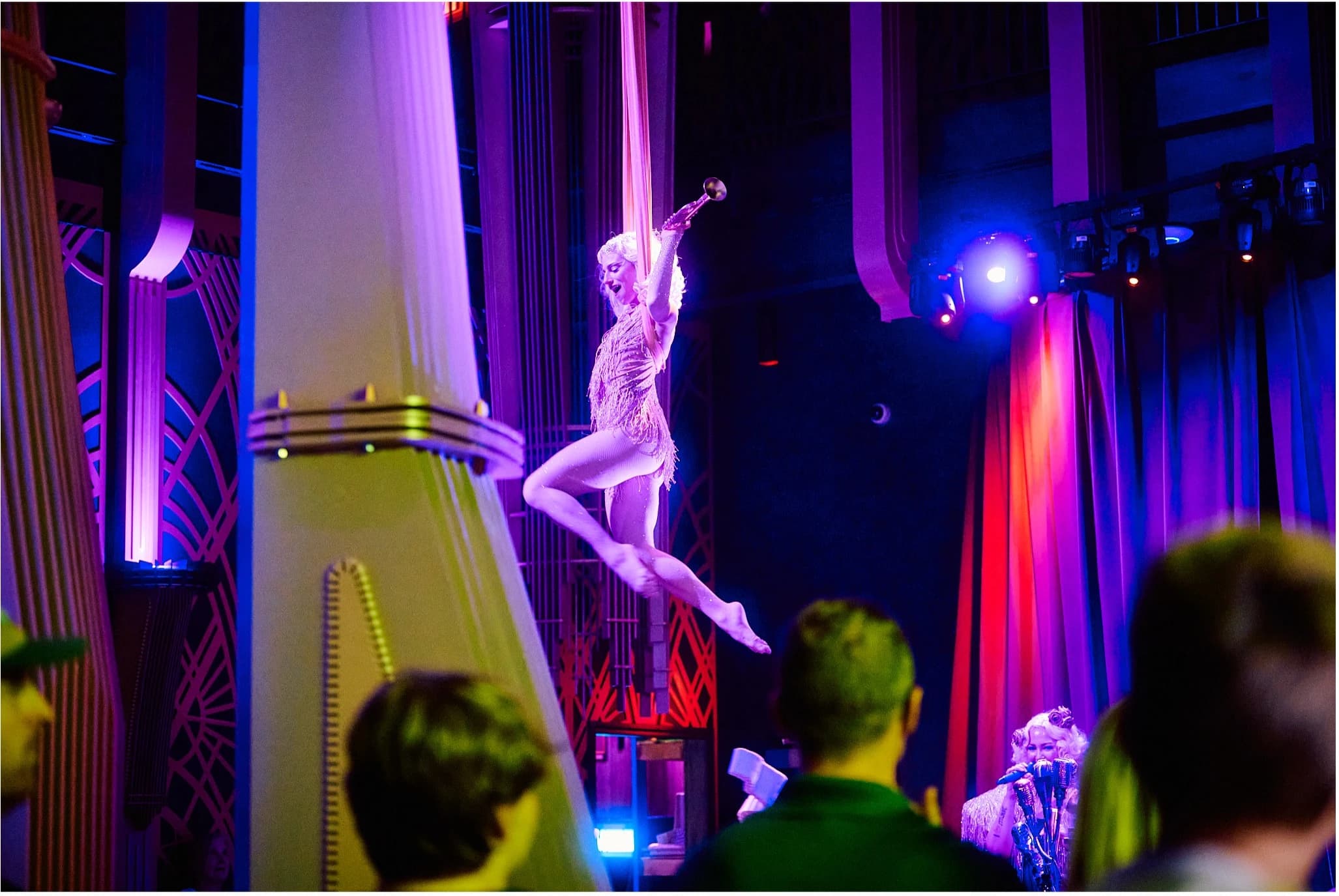
Aerial performer in a fringed costume suspended mid-air above the crowd in a neon-lit jazz club, with dramatic purple and blue stage lighting and audience members watching from below.
7 min

Atlas 9: Inside the Immersive Sci-Fi Art Experience

By Xiao Faria daCunha

Atlas 9 is a massive immersive sci-fi art experience packed with hand-built sets, interactive puzzles and hidden stories, inviting visitors to explore a thrilling cinematic world.

If your favorite shows include “Warehouse 13,” “FRINGE,” “Primeval,” “The Librarians,” or the classic “X Files,” there is a new immersive, interactive art experience with your name on its doors.

What is the “Atlas 9” immersive sci-fi experience?

With over 45,000 square feet of hand-crafted sculptures, installations, and structures, “Atlas 9” tells the story of an abandoned theater that became alive when a desperate attempt to revive the business went pear-shaped. What started as an experiment to deploy a new and more powerful projection system for the movie screens not only turned the theatre into an active anormalie – a site of unusual occurrences dominated by a mad scientist, the stray radioactive energy also allowed scenes in the movies being screened to breach reality and twist each viewing room into a different world.
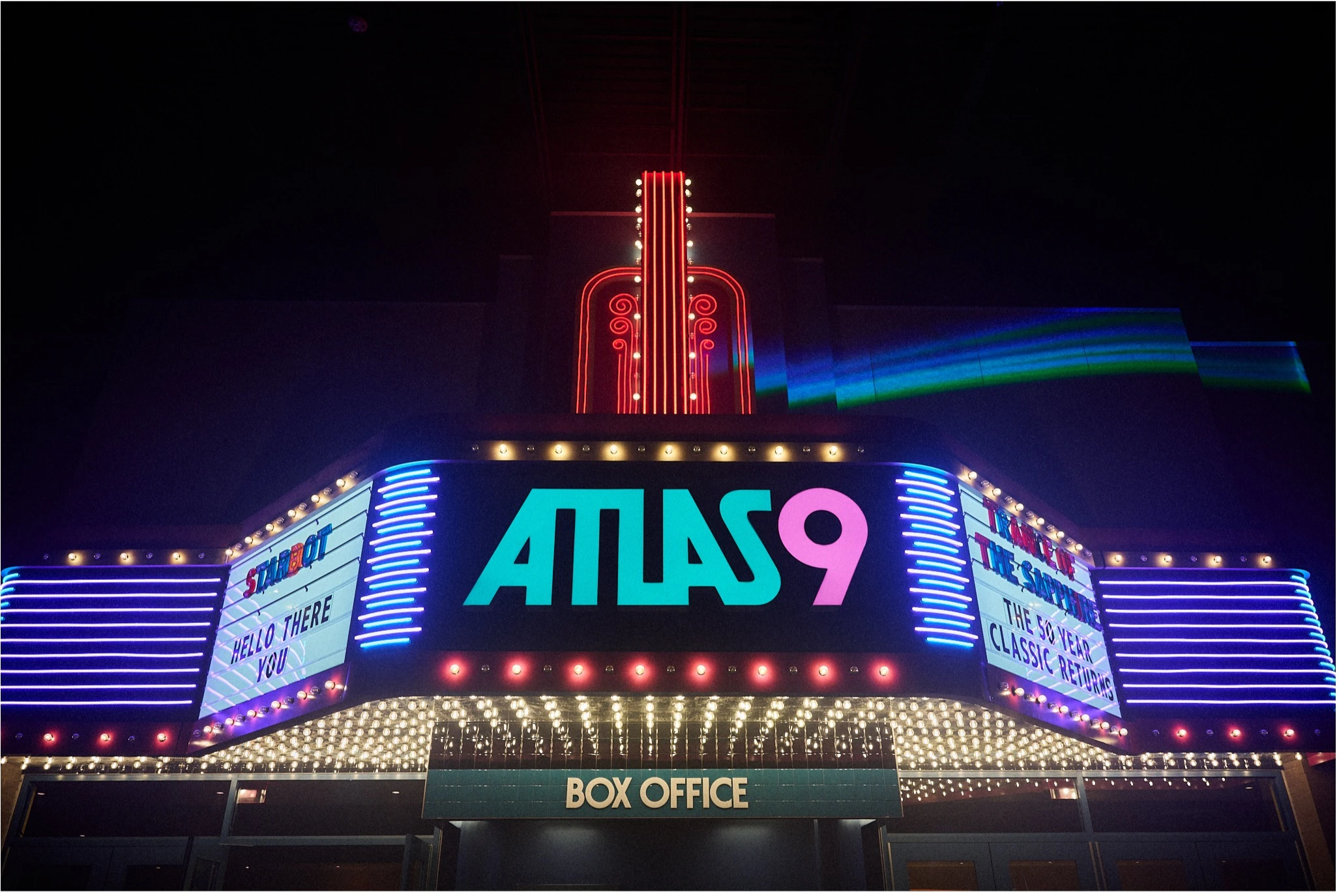
Neon-lit Atlas 9 cinema marquee and box office at night, with colorful lights and signage glowing against a dark sky.

Atlas 9 Box Office at night. Photo courtesy of Violet PR.

In response to the catastrophe, F.A.C.A.D.E, an organization specializing in containing and investigating anormalies, intervened and secured the theater, looking for ways to unlock its secrets and, hopefully, restore it back to its desolate but safe previous state – and that’s where your adventure begins. The story and design drew inspiration from various culture and eras, ranging from Mayan spirituality to classic bedtime stories, psychedelic experience to American jazz, with countless secrets, ephemera, and lore awaiting the visitor’s discovery.

Exploring the rooms: from concessions cavern to jazz club

The “Atlas 9” experience begins immediately. The entry ticket comes in wrist band form and serves as your F.A.C.A.D.E agent pass, containing a microchip that allows visitors to unlock secret clues and information using the terminals installed throughout the facility, as well as checking their progress and documenting what’s been found.

Once on boarding is complete, guests are free to explore in however way they prefer as there is no “correct way” of completing the experience. If one prefers to admire the artwork and simply enjoy the impressive construction of the massive facility, they can walk from room to room. Nearly everything can be touched, squeezed, moved, or interacted with, providing plenty of sensory and visual stimulation.

For example, the concessions cavern has giant popcorns and licorice strips going all the way up to the ceiling. The popcorns are made with sculpting foam and are perfectly squishy with just the right amount of roughness that will keep someone rubbing on them. On the floor are pop-corn go-carts for adults and children alike for a fun, smooth ride. The licorice room is a harder in texture, featuring endless spiral patterns and comfortable, solid benches for you to sit and try to decipher whatever secret the swirls and twirls contain.
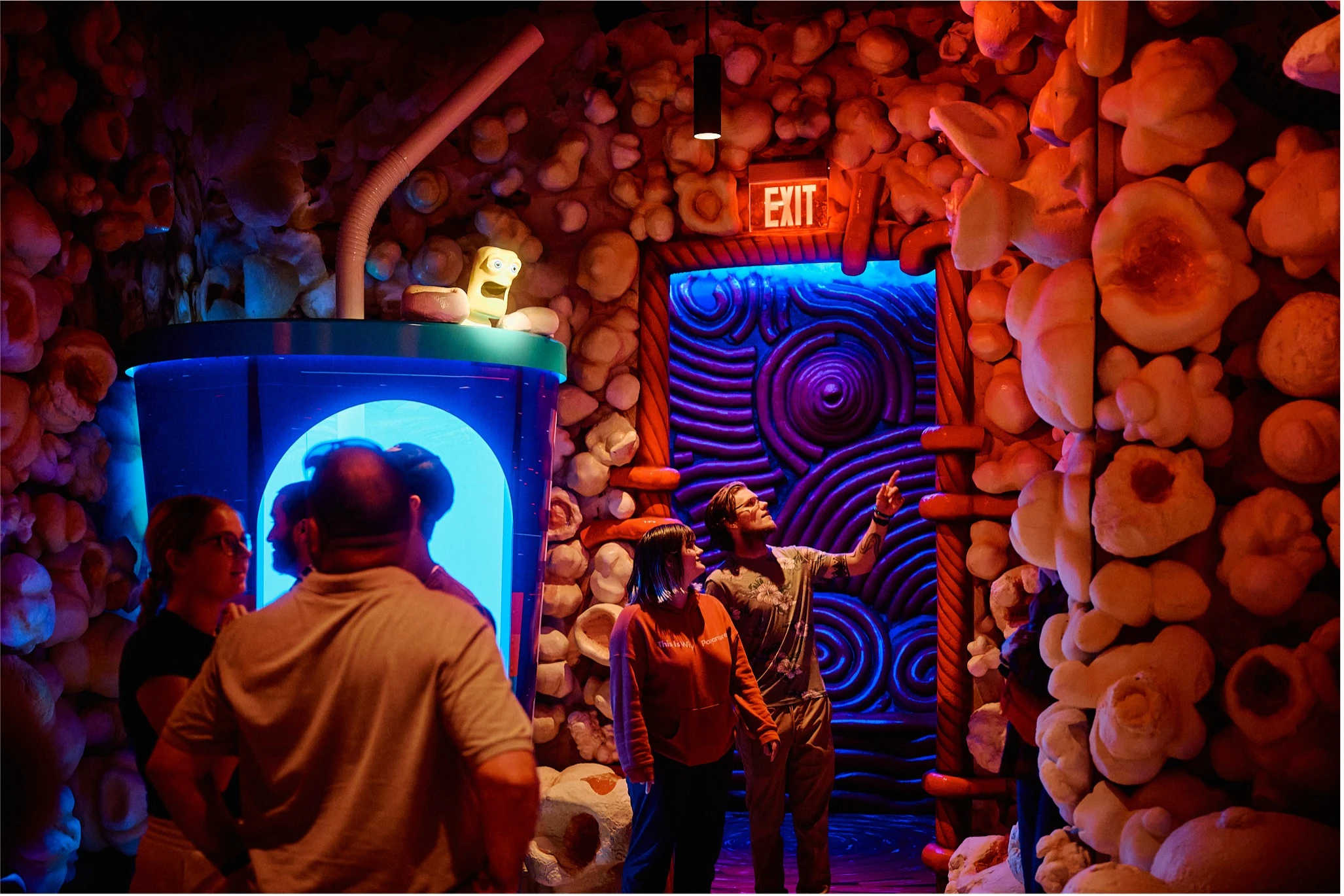
Visitors explore a surreal, brightly lit concession room at Atlas 9, surrounded by sculptural wall textures and glowing blue and red lights.

Concession Room at “Atlas 9.” Photo courtesy of Violet PR.

For those preferring to watch and chill, there is a beautiful jazz club featuring live music, aerial dancers, and magic performances scheduled at set interval. Most of the performances are interactive, and audiences are given props like mini instruments so they can collaborate with the performers on the stage. Even the seats are special, equipped with controls that allow the audience to send beams of pulse lights up the flute into the ceiling. The architecture is also stunning, filled with classic Art Deco elements such as gilded silver accents, a soaring central tower cluster, and an intricate, mutli-layered ceiling resembling a giant sunflower.

Alternatively, you can sit in the actual theater and watch how the projector came into place, and exactly what went wrong toward the end as the mad doctor explains his ambitious project in fascinating details. In the screening room, you will find special seats with unique controls that allow you to interfere with the silver screen: to change its color, distort the image, or leave a ripple trail across the screen. The video also shows some more backstories of the different movies being shown, including behind-the-scenes, director’s interview, and more.

Puzzles, clues and hidden stories inside Atlas 9

While a straight walk through “Atlas 9” may take no more than two hours, you can well spend over seven hours (as tested and proven), if you went full on agent-mode. After all, investigation and puzzle-solving makes up the majority of the experience at this establishment.

Most puzzles are active puzzle, which only requires you to gather relative clues to understand how to maneuver the mechanisms to reach the desired result. For example, the power supply core asks for both cylinders to be raised to the desired, highlighted level. Then, you’d push both handles down to activate the core. The sample room requires the player to first uncover the correct sequential combination for the correct DNA outcome, then simply enter the clues step by step into the interactive screen. The most challenging active puzzles is, without a doubt, the end-game terminal. It requires you to collect over a dozen different clues throughout the experience, including passive triggers and numbered or alphabetical passwords, or the correct sequence to flip a row of switches. Once complete, you’d finally be able to greet the mad doctor and find out exactly what happened after the projector rays had gone rampant.
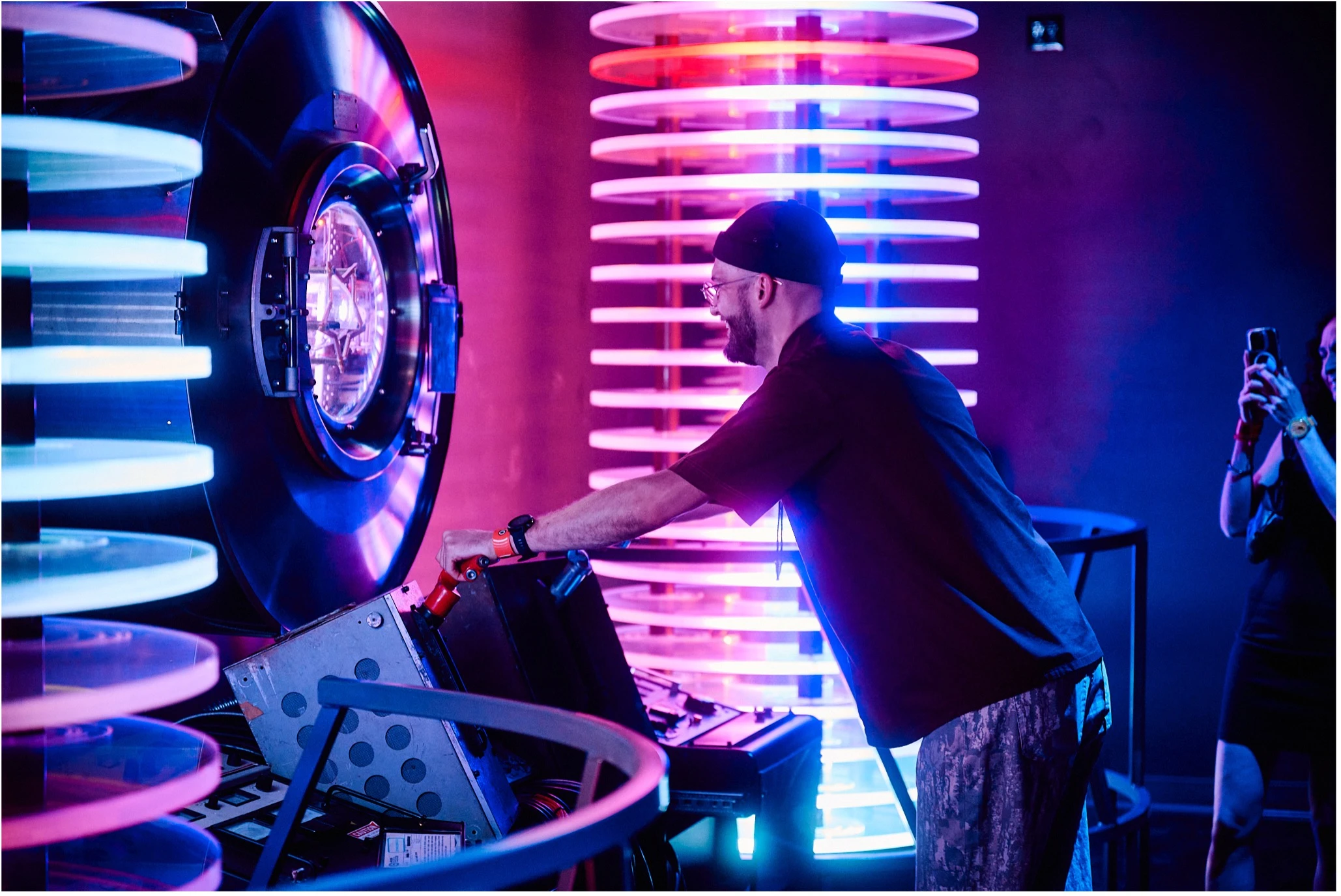
Man operating a glowing, sci-fi-style power supply interactive device surrounded by colorful neon lights while another visitor photographs the scene.

Power supply interactive device. Photo courtesy of Violet PR.

However, if you are up for a real challenge, or, if you are the collector personality who must unlock every achievement in a video game, “Atlas 9” is ready to occupy your attention. Every computer in the facility is fully functioning. Once unlocked with your wristband, you will find emails, video logs, and text clippings containing important information or banters between coworkers, bringing every character in the extensive narrative to life. Some of the email even requires you to report them because they were sent from spies hidden in the movie theater. There are also clue-cards throughout the facility, adding more context into each different viewing room, installation, and stored samples. Some may lead you to more critical clues tied to an active puzzle, others simply provide additional lore for your entertainment.

Once you’ve explored to your heart’s content, you can return to the lobby which contains a retro arcade. In addition to the classic games you’d seen in an 80s gaming lounge, the crew went as far as recreating the first arcade game in history, which hints where the fan-favorite “Space Invader” might have gotten its original inspiration. The crew also created its original “Atlas 9” game, which features the camper van installed by the entrance of the facility. Having traversed the dark yet colorful words inside the theater, the bright and playful lobby felt like a wake-up call, like you’ve finally emerged from another dimension and returned to your familiar reality.

Immersive dark room at Atlas 9 with swirling blue psychedelic wall patterns reflected on a glossy floor, and visitors walking through the glowing installation.

The Hypnotizer at “Atlas 9.” Photo courtesy of Violet PR.

If, by this time, you felt hungry enough, “Splice Bros” pizza parlor awaits you by the main entrance. This is a legitimate pizza parlor open to everyone, regardless if your F.A.C.A.D.E agent status. The parlor is a nostalgic kick for anyone who grew up during the 60s or 70s: lino floors, wooden counter, black leather seats, and small, plastic tables, plus retro posters on the wall and an old-school jukebox in the corner. The team made all the tables write-able, allowing guests to leave their comments on their experience or just a funny message for the next diner. The ceiling, on the other hand, is covered with movie tickets, suggesting the parlor has surely seen the theater from its rise, glory, to its fall.

The experience is complete.

Who built Atlas 9 and why it stands out

Dimensional Innovations, a design, build, technology firm based in Kansas City, was the genius behind this once-in-a-lifetime level immersive experience. Having spent a good portion of its 30 years of operations in designing signs and displays for venues, public spaces, and the one and only AMC theater group, the idea of building their own interactive art experience upon a movie theater concept came to the team rather naturally. Starting there, the company tapped into internal talents and collaborated with local, regional, and nationally renowned artists to bring the narrative to life. Love, dedication, and a profuse passion for imagination and innovation saturates the entire facility. Each returning trip reveals more details carefully woven into the experience, many beyond what the wristband can read and catalog.
Date

04.12.2025

Tags
Performing Arts & Live Eventsimmersive sci-fi art experienceAtlas 9 immersive experienceAtlas 9 interactive attractionstory-driven immersive worldinteractive puzzles and questshand-crafted sets and installationsimmersive theater experience
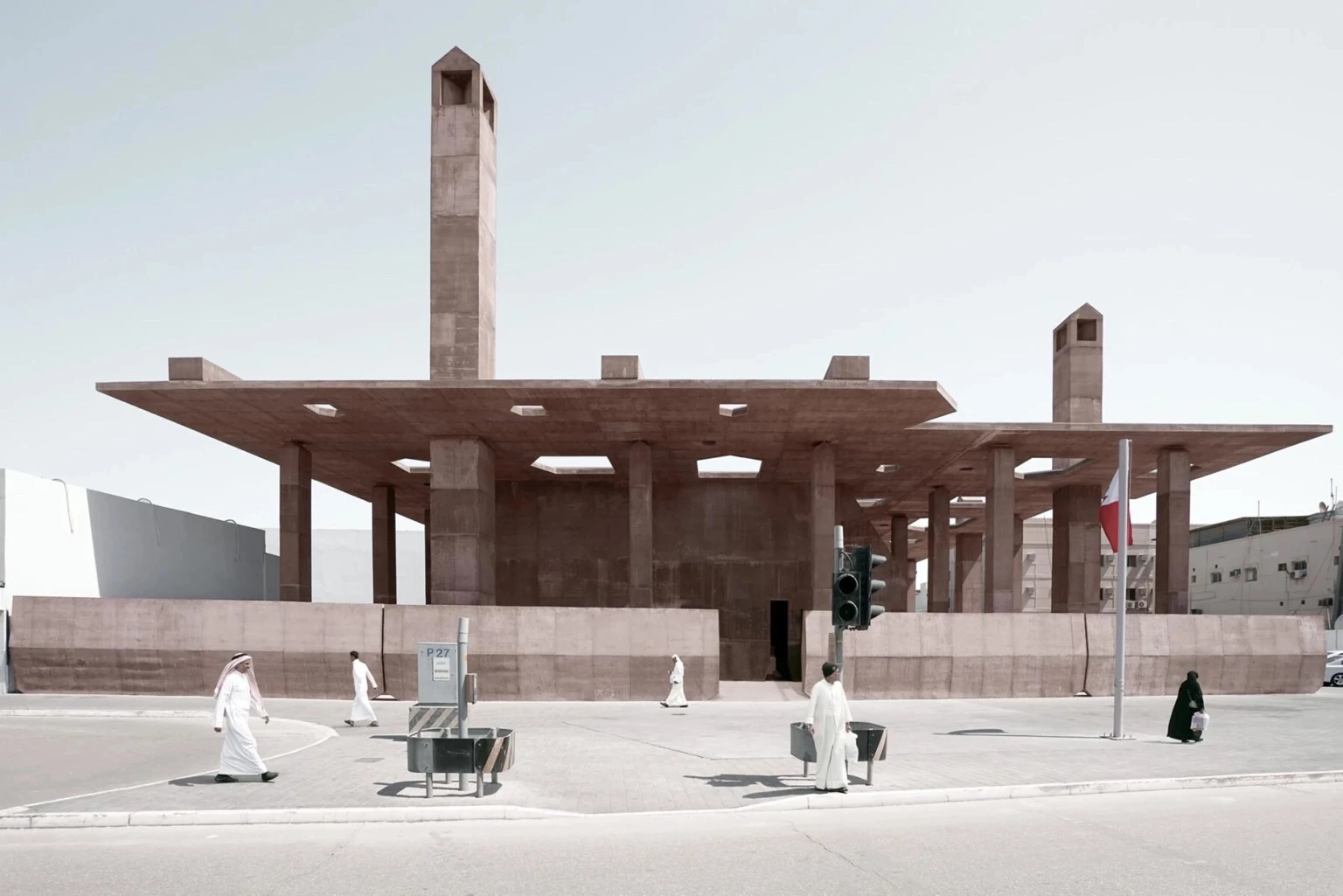
Pearling Path Visitor Centre in Muharraq, Bahrain – minimalist concrete building with tall columns and a wide flat roof, designed by Valerio Olgiati, with people in traditional dress walking in the foreground.
7 min

How Muharraq Became Bahrain's New Cultural and Architectural Capital

By Elene Pichkhadze

Discover how Muharraq became Bahrain's new cultural and architectural capital, from the Pearling Path Visitor Centre to car parks and sand-cast facades.

Unlike the monumental trends shaping much of the Gulf, Bahrain has taken a quieter, more introspective path. Muharraq, now emerging as the country’s new art capital, serves as an example of how tradition and innovation can, and perhaps should, go hand in hand. The large-scale redevelopment of the island’s historic heart reveals a vision forthe future rooted in continuity, revival, and the transmission of knowledge across generations.

Gigantic, ambitious projects of the Gulf, from The Line in Saudi Arabia to the Louvre in Abu Dhabi have long marked the era of giganticism, pushing the boundaries of innovation and presenting visions of a utopian future for the region.Yet these promises often clash with the harsh realities of the desert and the everyday needs of its people, working against the context rather than with it.

Bahrain’s Shift: Following the Pearling Path

In Bahrain, however, an intriguing new shift has occurred in recent years. Muharraq, a former capital of Bahrain, hasbeen converted to a new art hub, housing galleries, studios and art residencies that open doors to both local andinternational artists. As a part of the Pearl Path Redevelopment Project, initiated by the Ministry of Culture of Bahrain,old and new have come together. Monumental new construction projects were accompanied by a series of careful restorations of historic residences, cultivating a multi-layered dialogue across times.


As a part of this project, cities like Muharraq have become open stages for experimentation, allowing regional and international architects to interpret the Gulf’s vernacular language through their own perspectives. Visitors, drawn initially to the large-scale projects, find themselves instead confronted with something subtler: the transcendence of time itself.


This raises a question: what sparked this change, and what came first: art or architecture? As a UNESCO World Heritage Site, the Pearling Path project walks a fine line between preservation, restoration and innovation. This philosophy binds together the redevelopment approach, and today Muharraq presents itself as a vibrant mix of traditional houses and a cluster of new architectural projects, both detached, but in a communication with each other. Architect Noura Al Sayeh joined the initiative as a young graduate from EPFL in Switzerland, entrusted withrecommending architects for the Pearling Path’s contemporary additions. As a result, many of the new interventions were realized by European architects, each offering a distinct interpretation of the brief’s core principles.

A Personal Entry Point

My personal introduction to Bahrain began as a resident at the Art Station Bahrain, where I first encountered how vibrantand active the island’s creative community is. As a place that serves a mission, the old market building was renovated and repurposed as a creative centre, offering studio spaces to artists, as well as an active cultural program for the residents of all ages and backgrounds. The journey of renovation was an extended act of care, both for communities and spaces they inhabit. The project honored the legacy of the place, its craftsmanship, and its traditional materials. For instance, traditional wooden window screens were ordered from the last remaining local workshop in Bahrain: a gesture that speaks volumes about the country’s perception of its past and future.


A short walk through Muharraq is enough to be convinced: this project takes its millennia-long history seriously, allowing it to grow and evolve into new forms and contexts.


The Layered City: Valerio Olgiati’s Pearling Path Visitor Centre

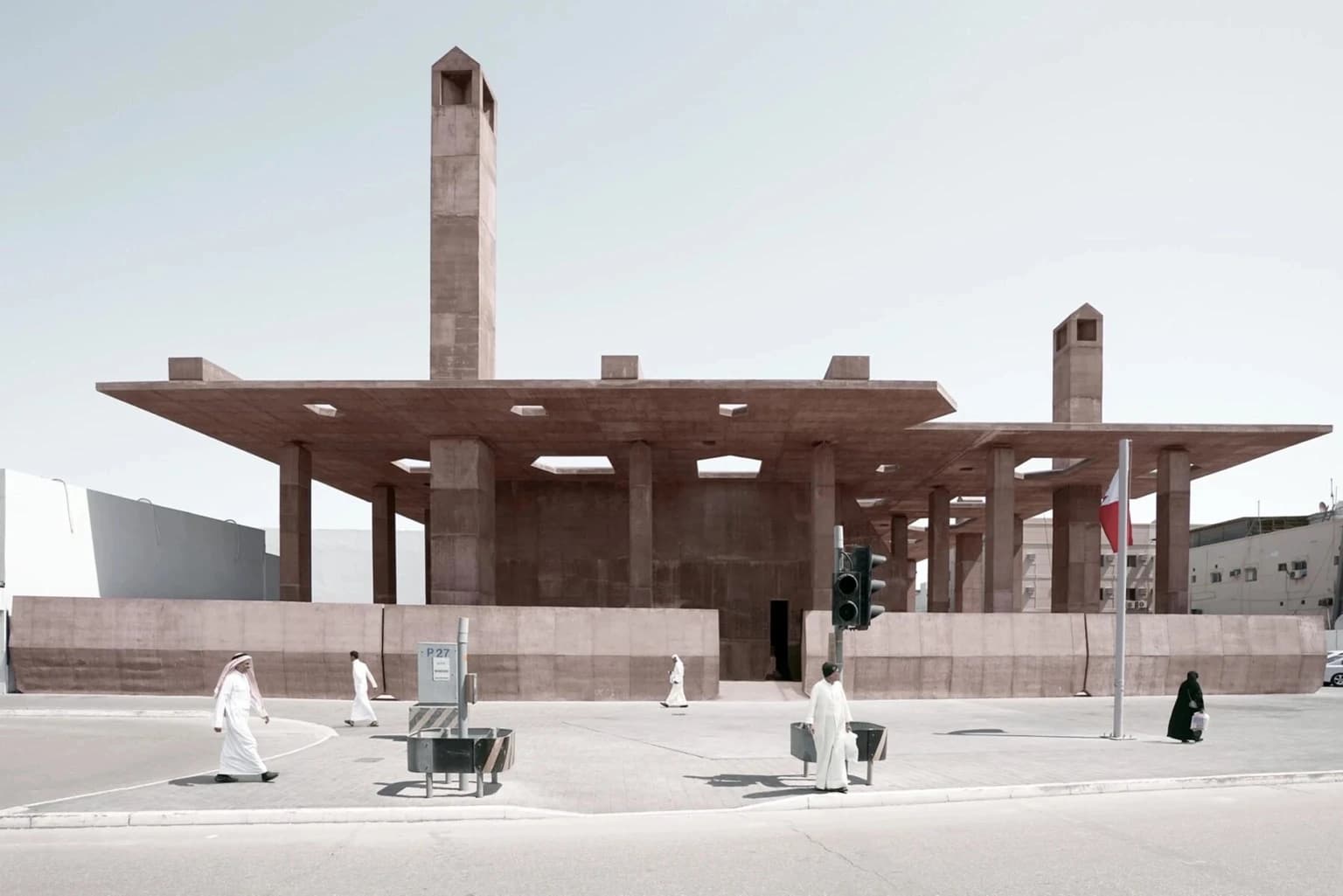
A natural starting point for this exploration of Muharraq is the Pearling Path Visitor and Experience Centre by ValerioOlgiati. The project perfectly embodies the logic of layering, so central to the city’s redevelopment. A massive, minimal concrete structure rises above and integrates the ruins of the Amarat Yousif A. Fakhro: a 1930s building that had fallen into decay by the 1960s. The center pays tribute to Bahrain’s pearling heritage while standing as a symbol of how the country’s architectural language evolves through dialogue with its ancestral knowledge.

Pearling Path Visitor Centre in Muharraq, Bahrain – minimalist concrete building with tall columns and a wide flat roof, designed by Valerio Olgiati, with people in traditional dress walking in the foreground.

Pearling Path Visitor and Experience Centre, Muharraq, Bahrain. Photo © Valerio Olgiati.

The station's exterior reads as almost brutalist, yet inside it unfolds as a series of semi-open spaces that flow naturally from one to another. This invitation of new experiences right next to the old ones is quite symbolic of Bahrain. Acting as a protective canopy over the buildup of buried history, the structure is supported by large, minaret-like columns. It exists somewhere between indoors and outdoors, between shelter and openness. Beyond just a pearling history museum, it hosts events, such as Muharraq Nights, bringingshops, food and live music into its courtyards.


The Concrete Experiment: Christian Kerez’s Car Park Plot A

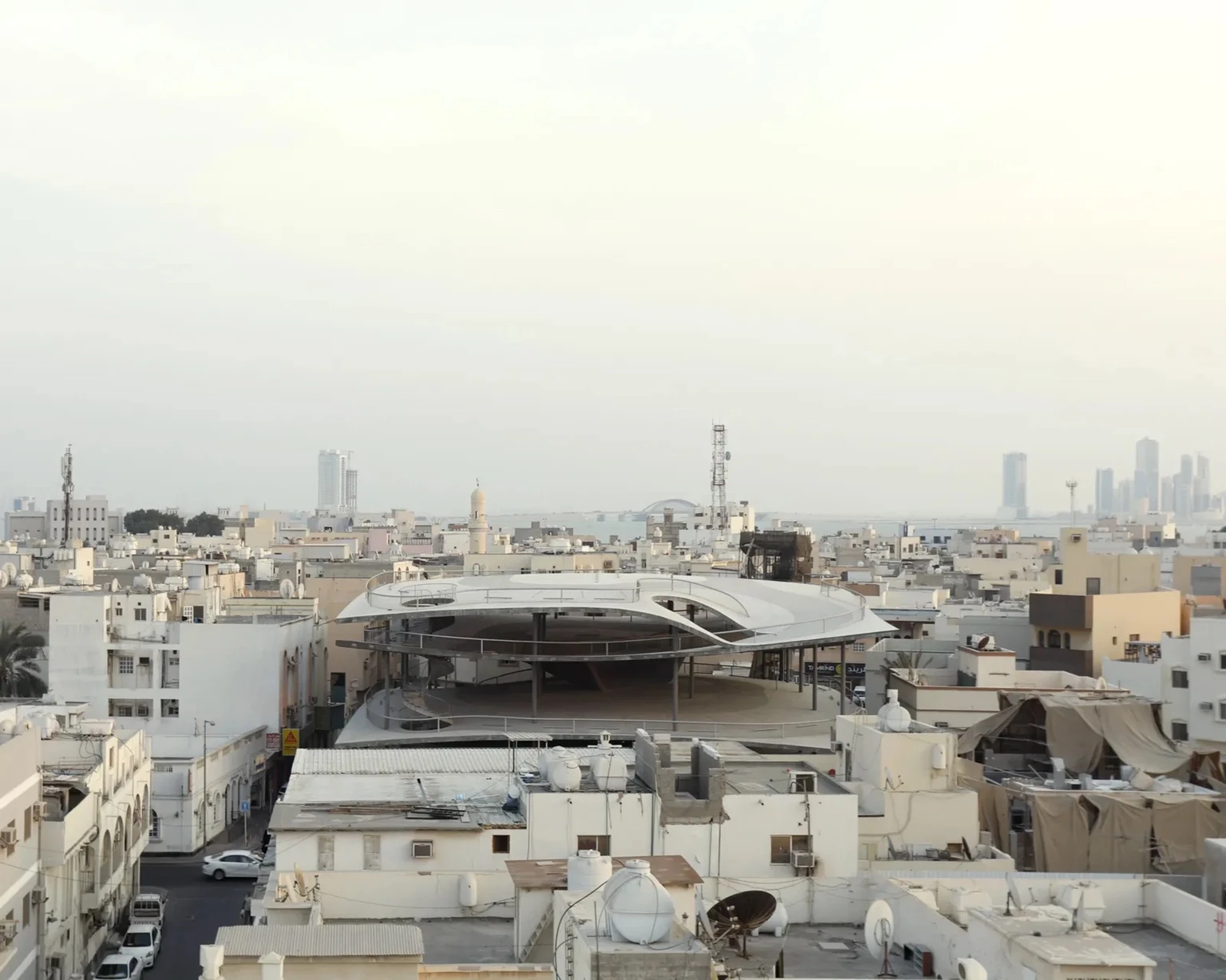
Further away from the visitors centre is a very ambitious parking lot, one of the series of Four Car Parks designed byswiss architect Christian Kerez. Brutal, concrete and sculptural, it takes an alternative approach towards the samematerial, bending and manipulating it till it becomes almost fluid and soft.

Aerial view of the shaded Car Park structure in Muharraq, Bahrain, designed by Christian Kerez, surrounded by dense low-rise buildings with the modern skyline visible in the distant haze.

Car Park, Muharraq, Bahrain. Photo © Maxime Delvaux.

Car Park Plot A, an extravagant reminder of how much space cars demand in modern life, stands in tension against long and narrow pedestrian streets of Muharraq. Remaining half-empty at times, this parking lot is an inserted statement: we are here to define what the future can look like.


The slabs of these buildings bend and slope, merging into each other so that they also serve as ramps connecting one level to another. No two slabs are identical, creating an endlessly varied geometry that required enormous precision and labor, with more than 75,000 cross-sections cut for the wooden formwork molds on site. Although the dominance of concrete feels counterintuitive toBahrain’s climate and sustainability needs, the structure transcends its utilitarian purpose. It becomes a flexible urban platform that can shift according to the community's needs. The result is an ambiguous project that has been received differently among the locals.

Material Memory: Studio Anne Holtrop’s Green Corner Building

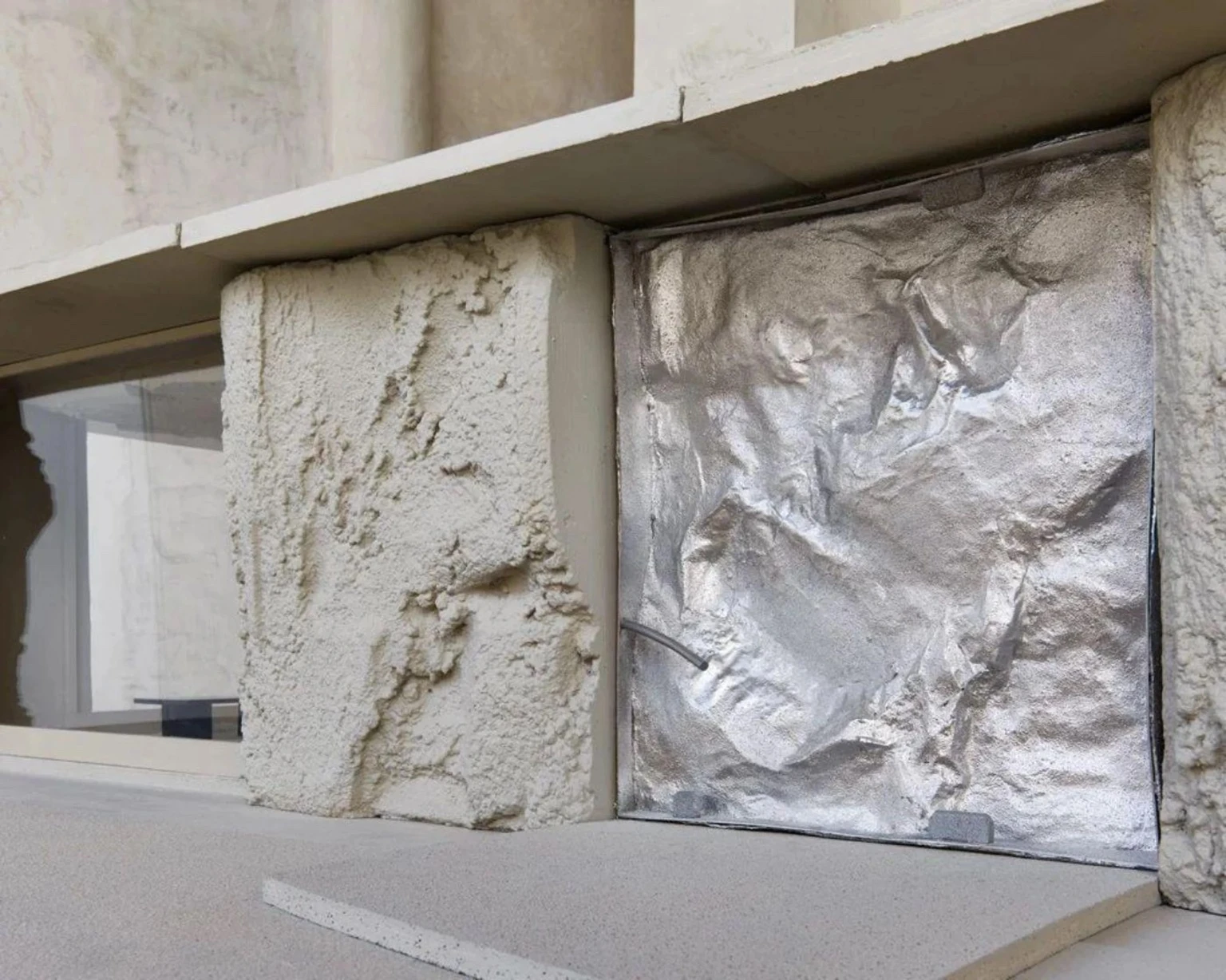
Among these projects, one studio stands out with a particularly extensive work in Bahrain. From designing the BahrainPavilion at Expo Milan 2015 to completing and planning several ongoing projects of varying scales and purposes, Studio Anne Holtrop has developed a distinct methodology and language deeply rooted in the Bahraini landscape. Built prior to Car Park Plot A, and now almost touching it, stands the Green Corner Building, one of Holtrop’s key works inMuharraq. Exploring the realities of desert life through materiality, the studio suggests that traditional ways of building are no longer sufficient. Instead, new approaches must emerge: ones that respond to the environment not by resisting it, but by becoming part of it.

Close-up detail of the Green Corner Building in Muharraq, Bahrain, by Anne Holtrop, showing rough textured cream plaster next to a crumpled metallic silver panel set into the facade.

Green Corner Building, Muharraq, Bahrain. Photo © Anne Holtrop. 

Using sand-cast metal and stone slabs, Holtrop’s architecture captures new histories and reinterprets the lived experience of the subtropical desert. This tactile engagement with material marks a shift in his practice after his relocation from the Netherlands to Bahrain. Here, he found a resonance with the principle that architecture and thenatural environment are composed of the same matter, blurring the boundary between the built and the found. This vernacular shift has since become central to his evolving body of work across the region, reappearing in Al Qaisariya Souq and Siyadi Pearl Museum.

Knowledge as Architecture: House for Architectural Heritage

Completed in 2016, House for Architectural Heritage designed by Noura Al Sayeh and Leopold Banchini Architects exemplifies the concept of “insertion” architecture: new interventions that hold up existing ones, while filling the emptyspaces with their presence.

Long and narrow, its windows open up to facades of neighbouring historic houses. Containing knowledge of Bahrain’s architectural heritage, the building unites narratives not only as documents for researchers but also as elementsembodied within the structure. This purpose is communicated on all levels. Offering a section-cut view into the city, onecan see histories accumulating and overlapping, both inside and outside.

Dedicated to preserving and showcasing Bahrain’s architectural legacy, it houses an archival collection of sketches and drawings by architect John Yarwood. In a way, it’s a showcase that looks from inside out, as the inner glass facades can be completely opened, uniting the exhibition space with the exhibition content of the surrounding walls.


A Culture of Continuity

The ambition behind these initiatives takes an alternative route of implementing and incorporating the rich heritage ofBahraini art, architecture and culture. Those projects do not aim to replace nor suggest an alternative development, but rather a cohabitation of present and past, that is so visible in the local philosophy and culture itself. While honoring historical roots, Bahrain’s art and design scenes continue these stories, continually exploring innovative approaches to familiar materials, crafts, and contexts.

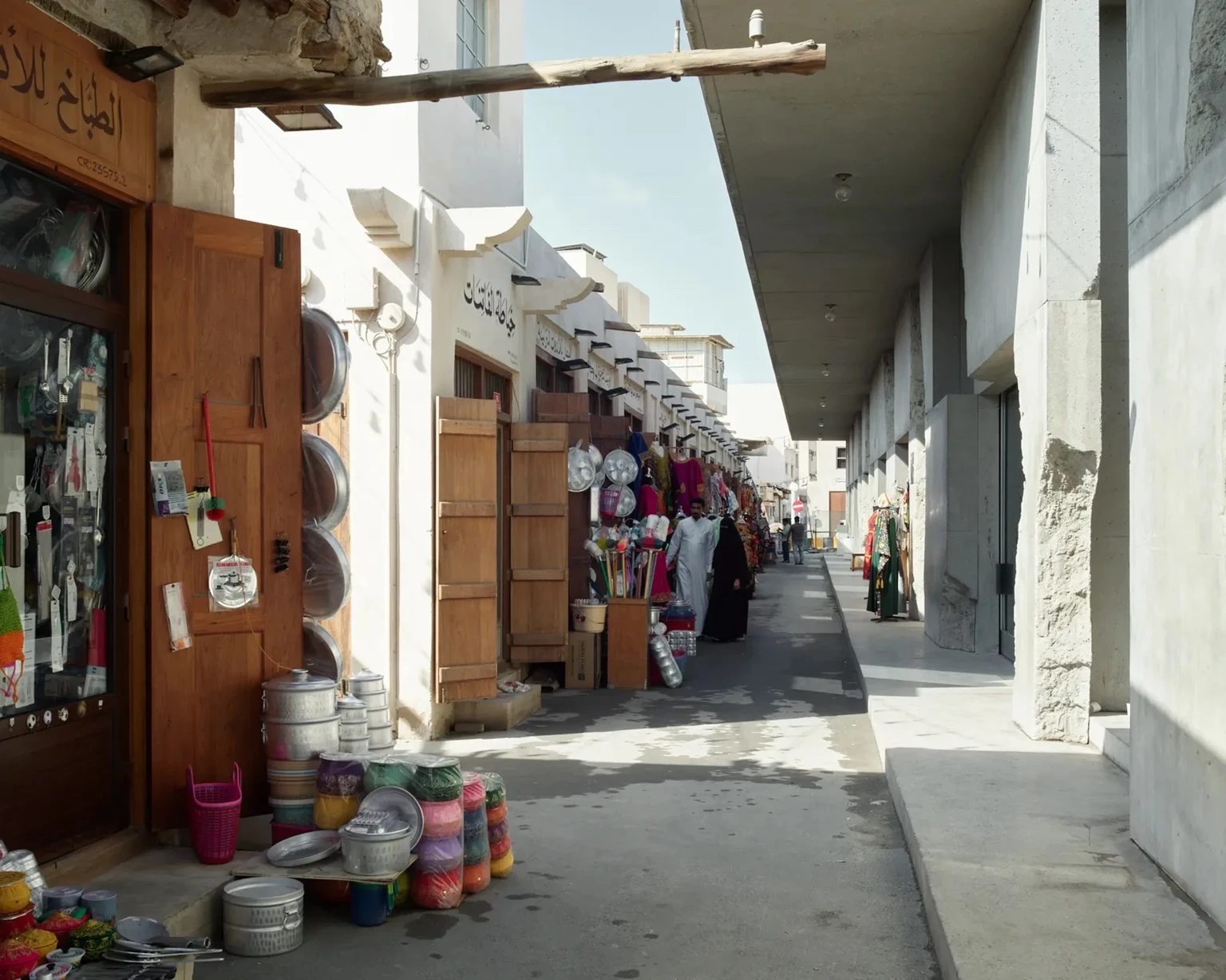
View along the Suq Al Qayssareyah and Ammarat in Muharraq, Bahrain, with market stalls, colourful household goods and clothing spilling into a narrow alleyway, framed by traditional wooden doors on one side and the rough concrete facade by Studio Anne Holtrop on the other.

Suq Al Qayssareyah and Ammarat, Muharraq, Bahrain. Photo © Anne Holtrop.

Revival is the one word that comes to mind when thinking about Bahrain and its approach. It is as if the country insists: we cannot move forward without taking our tradition and craft knowledge with us. And this is where the scene finds itself today. This communion still must withstand the test of time, now in dialogue rather than in detachment.

In essence, Bahrain’s shift is not just a return to the past, but a reimagining of how memory, material, and modernitycoexist. What emerges is not just a new urban identity, but a lesson in how continuity can itself be a form of progress.

Date

03.12.2025

Tags
Architecture & Spatial Designbahrainmuharraqpearling pathgulf architecturecultural capitalurban regenerationheritage conservationcontemporary architecturepublic space designunesco world heritagevalerio olgiatichristian kerezstudio anne holtropnoura al sayehhouse for architectural heritagegreen corner buildingcar park plot amiddle east art scenearchitecture and culture