Visitor walking past a large blue inflatable tunnel installation at the Balloon Museum.
7 min

Balloon Museum Chicago 2025: EmotionAir Inflatable Art Exhibition of Play, Healing & Wonder

By Xiao Faria daCunha

Explore EmotionAir, art you can feel at Balloon Museum Chicago 2025: an immersive inflatable show of touch, play and sensory installations that spark joy.

At night, I go on board and say

Good-night to all my friends on shore;

I shut my eyes and sail away

And see and hear no more.


My Bed is A Boat, from A Child’s Garden of Verses
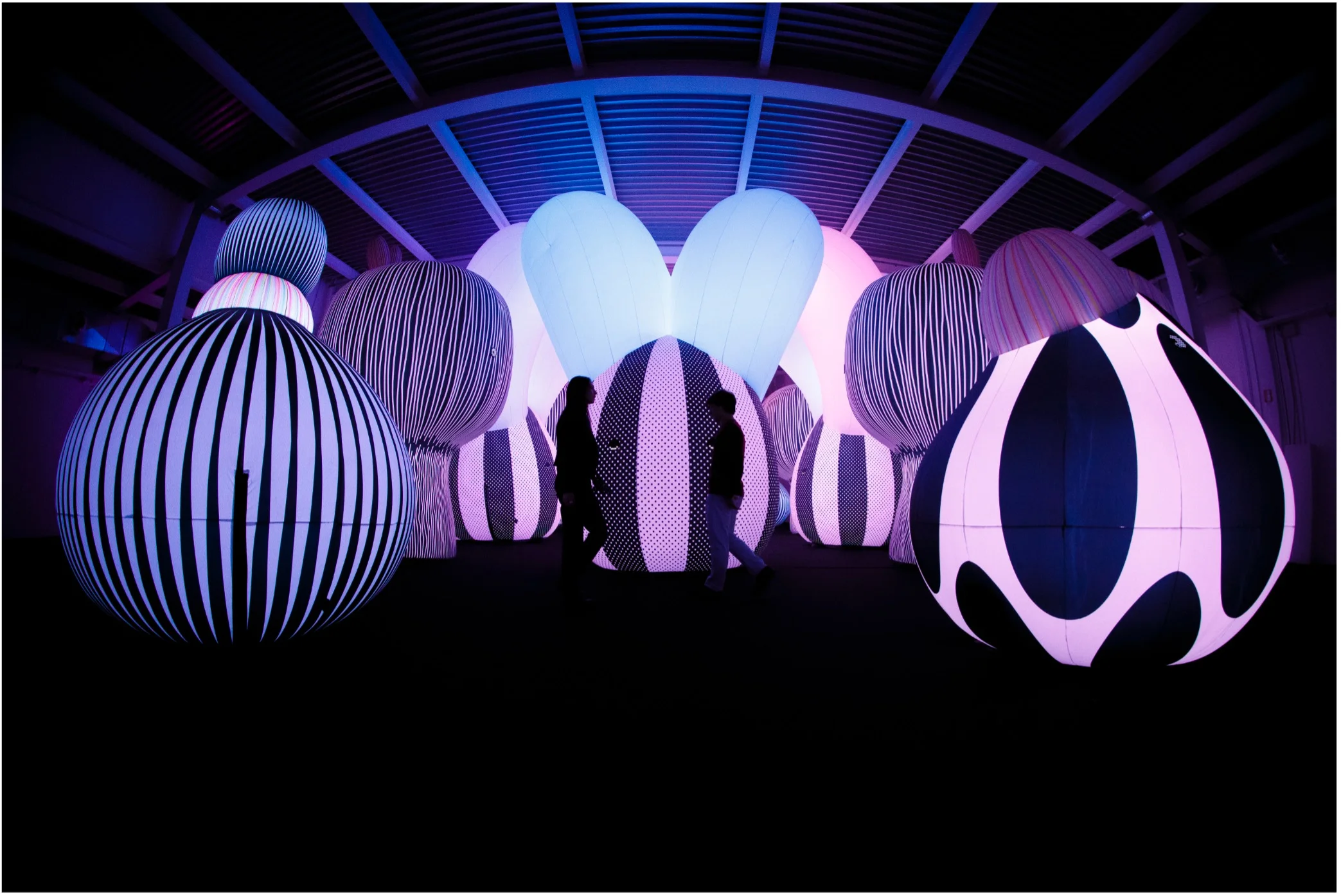
 

Immersive view of Airship Orchestra by ENESS at Balloon Museum, with visitors walking among glowing striped inflatable forms in purple and blue light.

“Airship Orchestra” by ENESS. Photo courtesy of Balloon Museum.

EmotionAir at Balloon Museum Chicago: Art You Can Feel

Chicago may have never needed more playfulness than it does now as political disruption and state-sanctioned violence sweep through the city. There are too many reasons to feel hopeless and deprived, and too few to feel hopeful and energized. In times such as the presence, childlike innocence may be one’s only salvation.

To touch is to live. To feel is to heal.

And when the public lives under a system designed to deprive of them of both, art that engages our senses of wonder may be the last sanctuary.

And what’s more wonderful than an entire museum of inflatable art you can touch, feel, hug, sit on, and play with?

“EmotionAir: Art You Can Feel,” Balloon Museum’s groundbreaking immersive experience, opened at The Fields Studios in Chicago on Thursday, October 30 and runs through April 6, 2026. Featuring large-scale installations and inflatable works created by internationally renowned artists, the exhibition is designed to engage the visitors’ five senses, using touch, feel, and play to create a sensory journey connecting the audience and the art on a soulful level.

Stepping into the exhibition is like being transported into an interactive children’s book. Every movement engages the installation, and pulls the viewers off the bystander’s seat and turns them into a co-creator. There is no set ways of touring the exhibition, nor the proper sequence of experiencing each piece. Alas – “EmotionAir” expects the audience to run wild, experiment, explore, and become mesmerised by the most simple things like a curious child.

Key Installations to Experience

For example, “10 Agosto,” a collaborative installation by Italy-based Hyperstudio and Elena Raimondi, is minimalist yet powerful. Inspired by the Night of San Lorenzo, the installation constructs a moving nightsky inside the museum’s space. Sitting on a swing, one watches the light globes floating above them move, spin, and collide as one sways, moves, or briefly suspends themselves mid-air. The pale, white lights coat the mist in blue and purple, creating a surreal environment that lingers between dreams and realities. Haven’t we all, at some point, sat on a swing set at night and wished we’d throw ourselves into the universe and dance with the stars? Now, that dream can come true at “EmotionAir.”

“Airship Orchestra” by ENESS is a generative soundscape synchronized with lights. The giant, bulb-like installation is projected with geometric patterns of dots and stripes, reminding audience of Yayoi Kusama’s pokadot world. Except the shapes here do not remain still. Instead, they shift and morph according to the music, leaving an open sky for interpretation. What do you hear? How do you feel? Do you see the shadows of cunning foxes following you through a dark forest, or millions of jelly fish flooding across the water above while you lay on the ocean bed?

While imagination and fantasy flow through the exhibition, “EmotionAir” does not shy away from critical contemporary discourses, either.

In “Somehow I Don’t Feel Comfortable,” Japanese artist Momoyo Torimitsu stuffed two oversize red rabbits into a cramped, room with black tile floors and empty white walls. One of them tower over the viewer, staring down with blank eyes and red, smiling mouth. The appearance is closer to a haunting monster than an adorable cartoon animal. The viewer, forced to step around the massive obstacles and standing under their looming shadow, likely quivers at the thought of being dominated by something that is supposed to be cute.
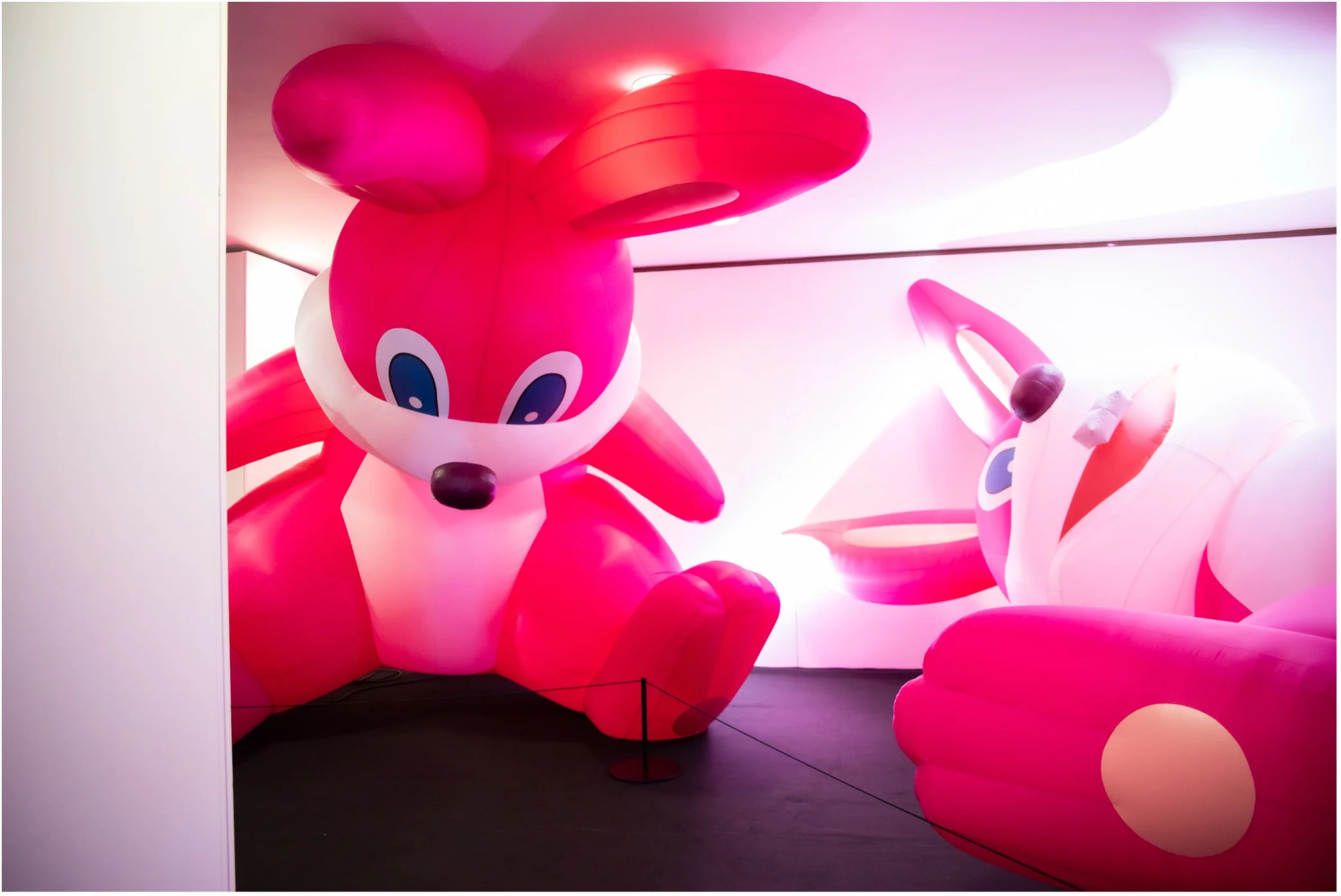
Large pink inflatable bunnies filling a tight white room, from Somehow I Dont Feel Comfortable by Momoyo Torimitsu at Balloon Museum.

“Somehow I Don’t Feel Comfortable” by Momoyo Torimitsu. Photo courtesy of Balloon Museum.

Here, Torimitsu uses their massive bunnies to cast a critical look at the discomfort behind the universal demand for cuteness in a world where kawaii culture has become overwhelming and universal. The artist conveys a sense of dis-proportionality through the scale of her work and asks the questions that are often ignored: What is cuteness in a world of distraught? Why is there such a sense of urgency to feel cute, be cute, and appreciate being cute? The same can be said with any cultural trends, if one were to think more expansively.

Meanwhile, UK-based Jason Wilsher-Mills used youthful colors, designs, and patterns to share the lived experience of the disabled community. Drawing inspirations from classic British children’s comic, 70s TV programs, and decorations from his childhood home, Mills created “The Argonaut,” which resembles an individual with disability lying down.

In Greek mythology, “the Argonauts” are a band of adventurers who accompanied the hero to Colchis to retrieve the golden fleece during the Trojan War. The name, quite literally, stands for “those who steer the ship of Argo,” which was the name of their boat.

For Mills, “The Argonaut” is a tribute for the unsung heroes in the disabled community with whom he’d collaborated over the years throughout his journey in Britain. Serendipitous sharing the same name as the Trojan hero, Mills drew parallel between the mythology and the reality, showing his deep respect to those who stood against adversity and continued their advocacy.​

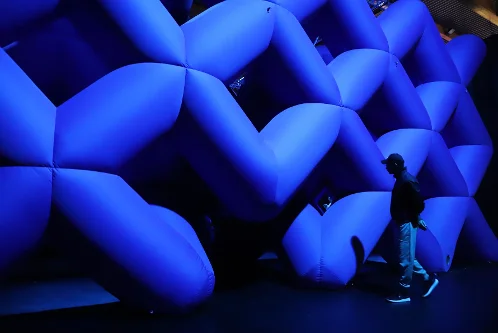
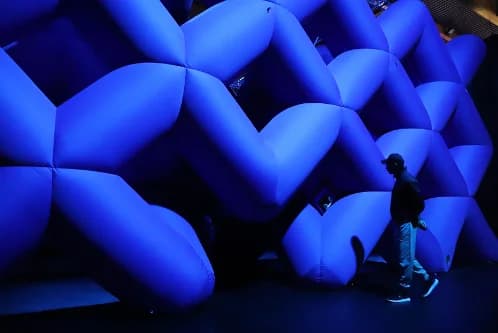
Visitor walking beside a large blue geometric inflatable tunnel from Cube Abyss by Cyril Lancelin at Balloon Museum.

“Cube Abyss” by Cyril Lancelin. Photo courtesy of Balloon Museum.

Finally, “EmotionAir” understands that every adult has an inner child who needs healing. In this immersive, imaginary experience, the “no”s we received in our younger days can be rewritten into acceptance and permission simply by recreating and reliving a negative experience.

For example, “ADA” by German-born, Portland-based artist Karina Smigla-Bobinski is all about overriding refusal with freedom. In this installation, the artist creates a transparent helium-filled sphere covered with charcoal sticks. The viewer interacts with the giant balloon by pushing, pulling, dragging, kicking, even, and the charcoal sticks hit the white walls, ceiling, and floor.

No “quit messing up the walls” in this room. Therefore, no interrupted creative flow. The artist encourages the audience to use their surroundings as the canvas and make marks to their heart’s content. Spend five minutes with the installation, or thirty. You are in control.

If “ADA” is about fun and freedom, then, “Cube Abyss” on the other end of the emotional spectrum, delving fearlessly into terror and paranoia. Created by French artist Cyril Lancelin, the installation creates a inflatable geometric maze that resembles everyone’s childhood nightmare: the road we did not choose, or a dark alley we always passed on a late night out of school. The dark stories we told ourselves about that abandoned warehouse building two blocks down the street, or the strange noises we swear we heard coming from our own closet… “Cube Abyss” invites the viewer to re-experience their irrational fear in a safe and comfortable environment – to feel the tension, absorb it, and come out of the other end. Maybe only by physically walking through the abyss can we finally lay our hidden terrors to rest.

Why EmotionAir Matters in Chicago Right Now

Playful, audacious, and compassionate, “EmotionAir” at Balloon Museum is a timely getaway from the dreadful reality and a necessary recharge for the tattered bodies and weathered souls of adults in the modern world.

There is no use denying the level of unrest and uncertainty being forced upon Chicago that does not seem to be ending in the very near future.

Nor is it possible to turn blind eyes and deaf ears to the sound of tear gas canisters or the angry roars of the people.

Many are scared. And more are furious. Fear and rage weigh down the soul. They drain us and exhaust us, leaving us too tired to fight another day.

Confronted with such a reality, embracing the sense of play becomes more significant and fundamental than ever.

In “EmotionAir: Art You Can Feel,” viewers must forget about every rule in a traditional art gallery or museum. Featuring 20 artists from around the world, the work on display varies from generative soundscape, audio-visual assemblage, ambient visual meditation spaces, to interactive co-creating adventures.  In a world that often feels too apathetic, too isolated, and too hostile, “EmotionAir” is a global effort to rekindle joy and wonder.

“Since the very beginning of the Balloon Museum, we have believed that play and wonder are not just elements of childhood, but powerful tools to create artistic experiences that engage everyone. Our mission is to transform what is light, ephemeral, and seemingly playful into a universal language that connects people across cultures. In this way, the most authentic and purest aspects of childhood become expressive means through which art can spark emotions, stimulate participation, and open new possibilities for dialogue with the public,” says Roberto Fantauzzi, CEO of Lux Entertainment.
Date

23.11.2025

Tags
Performing Arts & Live EventsBalloon Museum ChicagoEmotionAir exhibitionEmotionAir Art You Can Feelinflatable art museumimmersive art Chicagointeractive art Chicago 2025sensory art installationinflatable art experienceChicago art exhibition 2025healing through artplayful art installationAirship Orchestra ENESS10 Agosto Hyperstudio Elena RaimondiSomehow I Dont Feel Comfortable Momoyo TorimitsuThe Argonaut Jason Wilsher-MillsADA Karina Smigla-BobinskiCube Abyss Cyril Lancelin
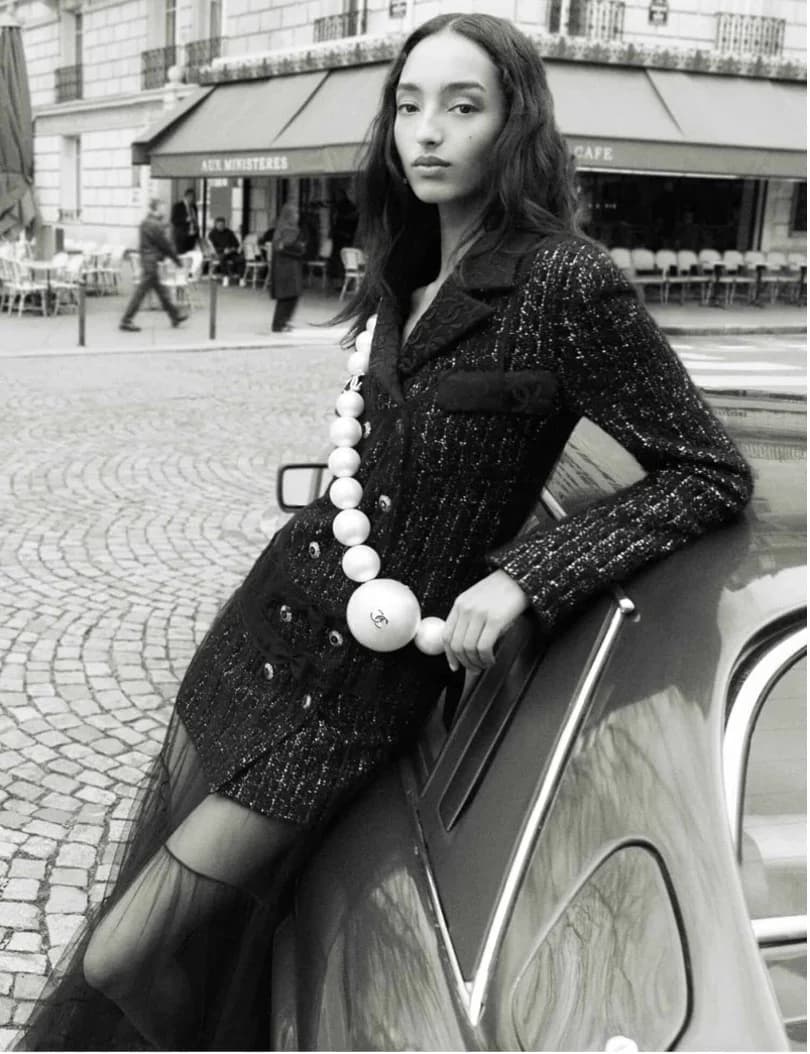
Black-and-white Paris street photo of a model in a tweed coat and sheer skirt.
6 min

Photography Trends 2025: Why Authentic Images Beat AI Pictures

By Ana Victoria Servigna

Discover the key photography trends of 2025, from film-inspired aesthetics and street photography to AI, drones, and emotion-driven storytelling.

Photography in 2025: Between Technology and Emotion

Photography, as a form of artistic expression, has been continuously evolving over the years. In 2025, we perceive photos influencing significant advances in technology and social media, serving as a primary mode of communication on these platforms. However, for those who view photography as a profound art and professional pursuit, certain trends and techniques are defining its landscape this year.

With the increasing use of AI for modifications, improvements, and edits by everyday people and even in major brand advertising, photographers are ironically embracing traditional techniques. This evokes nostalgia, human connections, and authenticity, whether for individual projects, advertising campaigns, or content creation, and regardless of whether photos are taken with the most advanced camera or a smartphone.

While a thorough understanding of every camera function and proper lighting in a studio remains relevant, including technical details like aperture, shutter speed, ISO, and post-production, it seems that what is most admired in photography this past year goes beyond mere technical mastery. It's the evolving application of these tools and the photographer's willingness to integrate them into their unique artistic vision that truly stands out.

Key Photography Trends Shaping 2025

Retro and Vintage Aesthetics

In 2025, several trends are emerging, reflecting how creatives are utilizing different visual styles. For instance, there's a strong appeal to retro and vintage aesthetics, achieved by using old cameras that capture faded colors and film-inspired looks, thus evoking nostalgia. Portraits will always remain an important part of photography, and natural lighting with an emphasis on authentic expressions has gained relevance, seeking to connect on a deeper emotional level.

Dark Tones, Shadows, and Mood

Dark tones are also trending, with shadowy tones and desaturated colors offering moods of mystery, melancholy, and sophistication.

Black-and-white photograph of a model leaning on a vintage car in Paris, from Chanel Fall-Winter 2025/26, photographed by Mikael Jansson.

Chanel Fall-Winter 2025/26. Photograph by Mikael Jansson.​

Street Photography and Everyday Stories

Street photography, though not a new trend, has seen renewed focus in recent years. Some photographers are dedicating themselves to capturing particular aspects of everyday life on the streets of specific cities or towns to create compelling storytelling. This often involves using phone cameras and instantly sharing in a vertical format on social media.

Drone Landscapes and New Perspectives

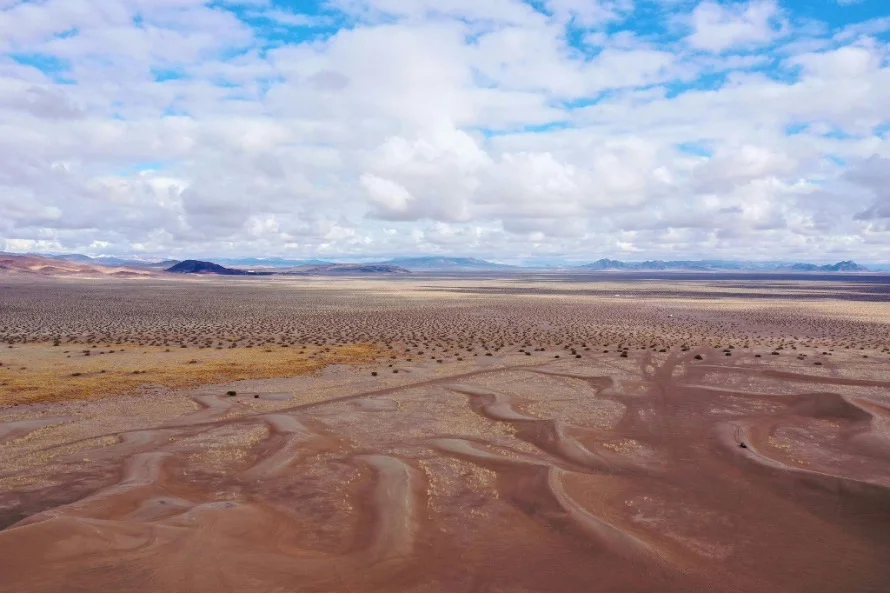
Drones are also becoming more experimental. Nature photography, in particular, has benefited from drones, capturing aerial views that offer fresh and comprehensive perspectives on landscapes, allowing us to admire the diverse textures and colors of natural environments.

Aerial photograph of the desert near Beatty, Nevada, with winding sand patterns under a cloudy sky. Photo by JD Garrett.

Beatty, NV, United States. Photo by JD Garrett.

Photography Inside Design and Branding

Photography also plays a crucial role in design trends. Brands are embracing a return to character and personality in their identities by reconnecting with their past. This involves blending photos with other visual elements like illustrations and creating organic collages that allow for experimentation. Visual storytelling in design is evolving, constantly seeking to provide imagery that evokes emotions, and photography, with its current vision in 2025, perfectly facilitates this exploration of human connection.

Personal Projects and Storytelling in Photography

Turning Lived Experience into Visual Narratives

Beyond offering commercial services, photographers are forging their own paths, expanding their portfolios with personal projects that are artistic and rich with storytelling. These projects often retail stories linked to personal experiences or aim to convey a particular theme. For example, addressing social issues or capturing specific feelings like nostalgia, love, or shared moments.

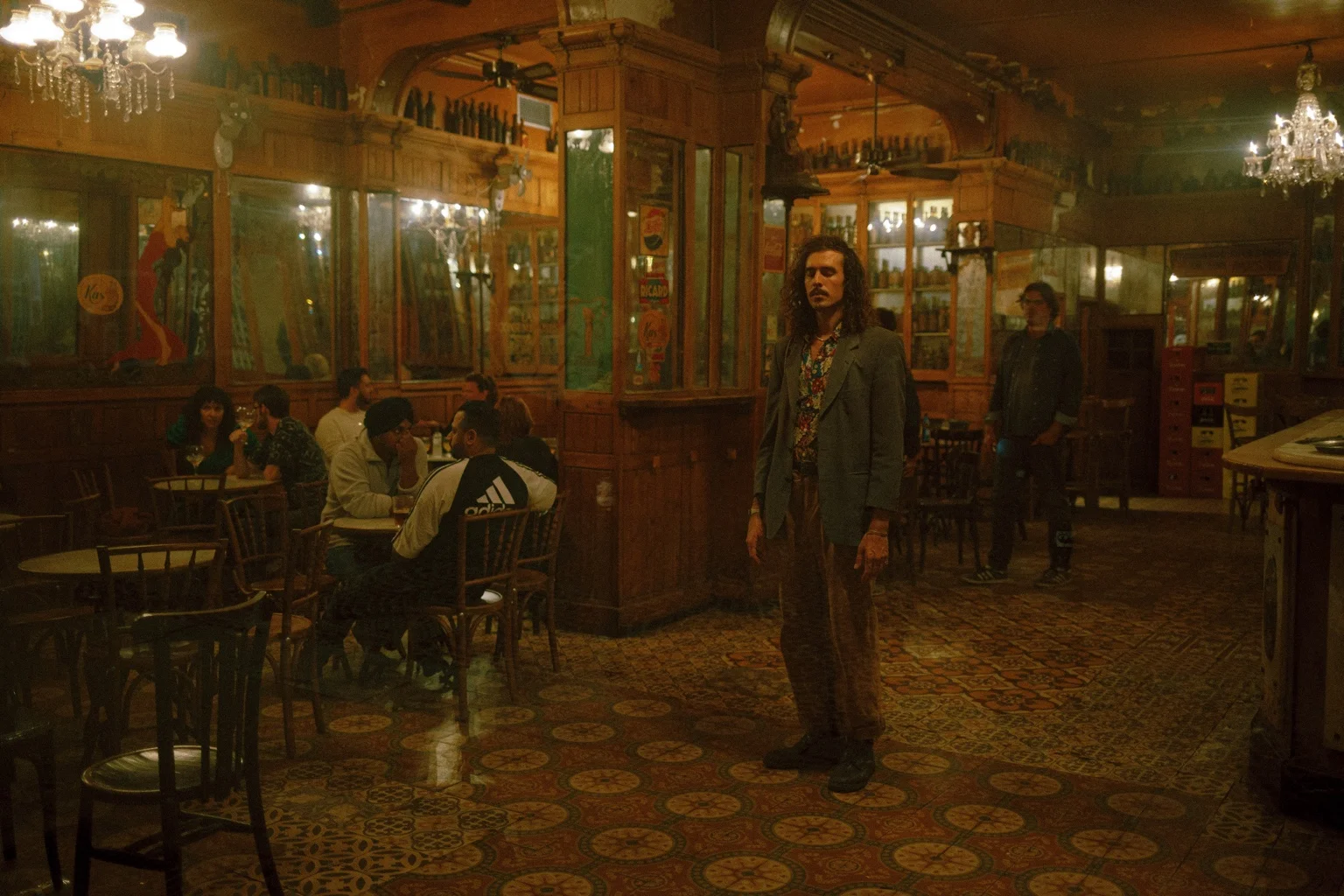
Marina Kalcheva, a photographer, videographer, and visual artist based in Barcelona, reflects on her art as a constant search for the philosophical side of her work. Her practice explores the tension between beauty and cruelty, precision and imperfection, capturing moments where shadows, light leaks, and varied textures converge.

A warm, cinematic photograph of Mateo Aimaretti standing in the middle of a vintage bar, surrounded by people talking at small tables under chandeliers. Photo by Marina Klcheva.

Mateo Aimaretti by Marina Kálcheva.

Voices, Representation, and Diverse Perspectives

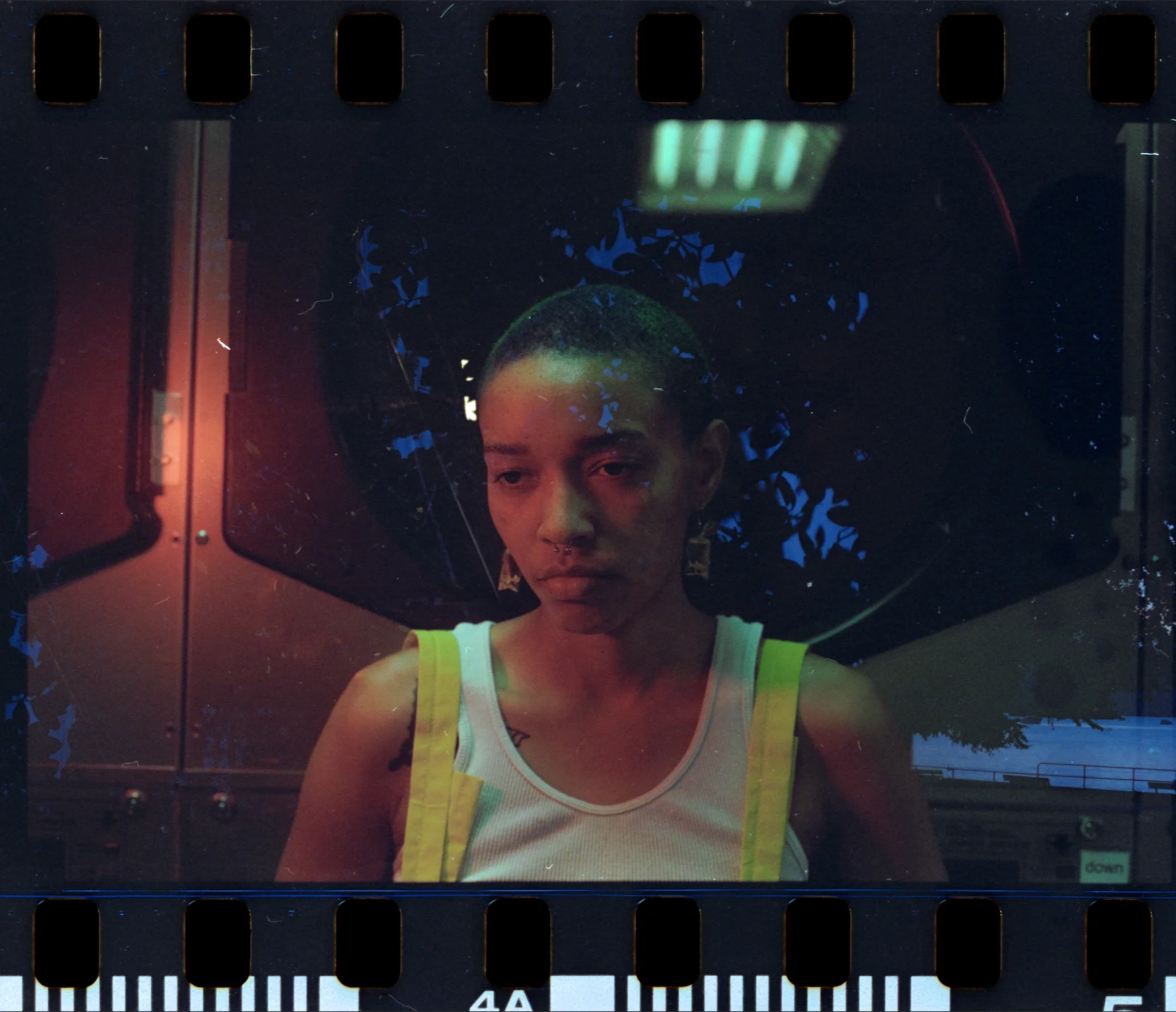
Self-taught Canadian photographer Merima Agovic has found a powerful form of expression in her art: capturing stories from diverse perspectives. Her work respectfully documents women, people of color, and the LGBTQ+ community, providing a crucial platform for voices that need to be heard.

Portrait of a person in a white tank top under moody red and blue light, framed by film sprockets and texture, from the series Long Gone by Merima Agovic.

Long Gone, by Merima Agovic.

Meanwhile, Calvin Koukoui, a French-Beninese photographer specializing in film, finds that portraits have the power to evoke emotion and reveal a quiet beauty in simplicity. He's found his voice in crafting original ideas and weaving them into a cohesive body of work.


The visions of these two photographers exemplify how each artist, in their own way, exposes and explores the themes of their art through photography. They emphasize the importance of genuine connection through visual storytelling, experimenting with different techniques and cameras while primarily focusing on defining the unique identity of their work.

Why Perspective Matters More Than Ever in 2025

In a world saturated with constant, real-time images that often lack depth and purpose, a thoughtful vision through photographs has become more important than ever. As technology, and more specifically AI, continues to rise in image creation, this context compels photographers to imbue their work with artistic value and authenticity.

Years ago, for example, during the 2010s, having the most up-to-date camera, the best lenses, and perfect technical knowledge was extremely relevant and often considered necessary for a good picture. Imperfections were avoided at all costs, and getting the "best shot" was paramount. This era was defined by rapid technological evolution from DSLRs to mirrorless cameras and the widespread integration of high-quality video features. Nevertheless, it was also during this time that social media platforms like Instagram began to take hold, especially among smartphone users, leading to the democratization of the medium and the proliferation of new trends like double exposure, flat lay photography, and the widespread popularity of the selfie. Instagram offered users a diverse number of filters that automatically experimented with lighting and colors, becoming so memorable that the entire era had very distinct visual filters, particularly from 2014-2016.

The rise of this platform also allowed professional, beginner, and amateur photographers to share their work and build an audience that could eventually translate into clients. From this time onward, photography underwent significant changes. The smartphone and the vertical format of Instagram stories profoundly altered the meaning of photography and the message behind it.

However, thanks to these shifts, photography might be experiencing a renaissance in 2025. As the obsession with capturing the "perfect shot" began to lose relevance, the recall of feeling the picture resurfaced as a crucial aspect of this artistic form. This year, among creatives, what goes beyond the literal image is what will gain respect and make photography powerful.

Learning the basics provides control over functions, which in turn gives photographers the tools to decide and be creative about how photos look and the message they convey. But the true power lies in being able to transmit something beyond just a simple image, whether in a studio or outdoors.

How to Create Powerful Images in a Smartphone Era

Some interesting insights emerge when considering how to achieve this when taking pictures with a smartphone, which is part of everyone's lives. Understanding photography as an art form emphasizes the creative decisions, technical skill, and emotional communication involved.

Infusing Emotion into Every Frame

Infusing a photograph with emotion is what truly connects it to the intended message. Without this emotional depth, an image merely exists as one of many, lacking impact and purpose. This focus on emotional transmission provides not only a clear direction for the photographer's creative journey but also cultivates a more engaged audience, drawn in by shared values and genuine connection.

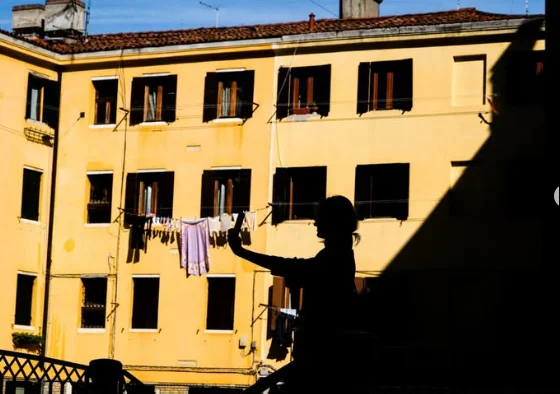
Silhouette of a person taking a photo in front of a yellow apartment building with laundry hanging on a line, in deep shadow and strong sunlight. Photo by Manolis Soulos.

Photo by Manolis Soulos.

Looking Beyond What’s Viral

Being aware of your surroundings beyond what's merely viral leads to creating a genuine vision and a personal perspective. This involves discovering unexpected photographic opportunities by noticing details and light, and improving compositional awareness of backgrounds.

Choosing the Right Camera: Film vs Digital

Choosing a camera that provides the photographer with the right tools to express their message is also key. Analog cameras, for example, have become increasingly popular due to their unique ability to capture light on a chemical emulsion, resulting in an organic look with rich detail and depth that digital simulations struggle to replicate authentically.

The Future of Photography: From Technique to Meaning

Whether in advertising, social media, or personal projects, photography in 2025 continues to carry the changes that began years ago, as photos became an important source of communication. We are now in a blend of technological innovation, artistic expression, and a growing emphasis on purpose and connection.

Clean portfolios still hold value, and mastering compositions remains a plus. However, industries like fashion, film, and other arts and culture sectors are now driven by the photographer's unique "fingerprint" of what they can offer to a brand, its distinct identity, and its purpose. Meaningful stories behind the lens are what seem to captivate most audiences and garner the most appreciation among other professionals.

Photography keeps evolving, and 2025 has the power to be the year when this art form recovers its most important essence: creativity. Photographers are being challenged to look inward, drawing upon their unique experiences and perspectives to craft visuals that resonate on an emotional level, ultimately elevating their craft from mere documentation to profound artistic expression. The future of photography in 2025 is not just about capturing light, but about illuminating stories and evoking genuine human experience. This becomes a pivotal moment where technical prowess is no longer sufficient; the ability to infuse imagery with soul and narrative depth becomes paramount.

Date

23.11.2025

Tags
Photography & Visual Mediaphotography trends 2025authentic photographyfilm photography revivalAI and photographywomen and LGBTQ+ representation in photographycreative photography projectsphotography as visual storytelling