Introduction: conspiracy culture and corporate media
The age of Conspiracy is around us! Prepare your tinfoil hats!
From flat earthers to anti-vaxxers, there will always be a dedicated community of people with alternative beliefs that go against what is mainstream. In the age of hypercapitalism, highly globalized corporations and media channels control the narrative that controls modern society. The illusion of choice is granted through subsidiaries, as we often forget that the media are not entirely independent; many large corporations have a stake in different media outlets, usually controlling the narrative for their audiences. In the age of corporate media, we as audiences demand more from the media we consume, and some even turn to alternative news sites to fully experience independence from mass-controlled ideologies. Truth serves as global currency traded amongst the conglomerates that control the narrative, and many are sick of it.
But what are the repercussions of embracing conspiracy and contrarianism? Are there any dangers in trusting alternative beliefs and facts?
Myth, bees and climate: what “Bugonia” really means
Yorgos Lanthimos’s Bugonia explores this idea, showcasing how an intricate web of conspiracy develops from one’s distrust of the world. Through Teddy, Don and their questionably innocent victim Michelle, we explore a story where beliefs in alternative facts based on conspiracy theories form and develop into a haywire mess of torture, murder and aliens. Sort of. Through Bugonia, Lanthimos explores humanity’s current sense of hopelessness in the state of the world and how it leads to a psychological connection to conspiracy theories. In an age of hypercapitalist global economies, it is hard not to wonder if maybe the age of destruction is not caused by us as a society, but the big corporations’ poisonous methods in forcing us into submitting to capitalism.
Bugonia’s exploration of conspiracy comes in layers. The etymology of Bugonia refers to the Greek Myth of the same name, derived from the ancient Greek words βοῦς (boûs), for “cattle”, and γονή (gonḗ), for “progeny”. Bugonia stands as an enduring symbol of death and renewal, a ritualistic phenomenon used to revive agriculture as recorded in Virgil’s Georgics. The core belief of Bugionia is that Death and Sacrifice are essential to maintaining the health of the earth. The story within Lanthimos’s Bugonia also follows the same fundamental belief: that, to save the Earth’s environment, sacrifices are necessary to reset the climate.
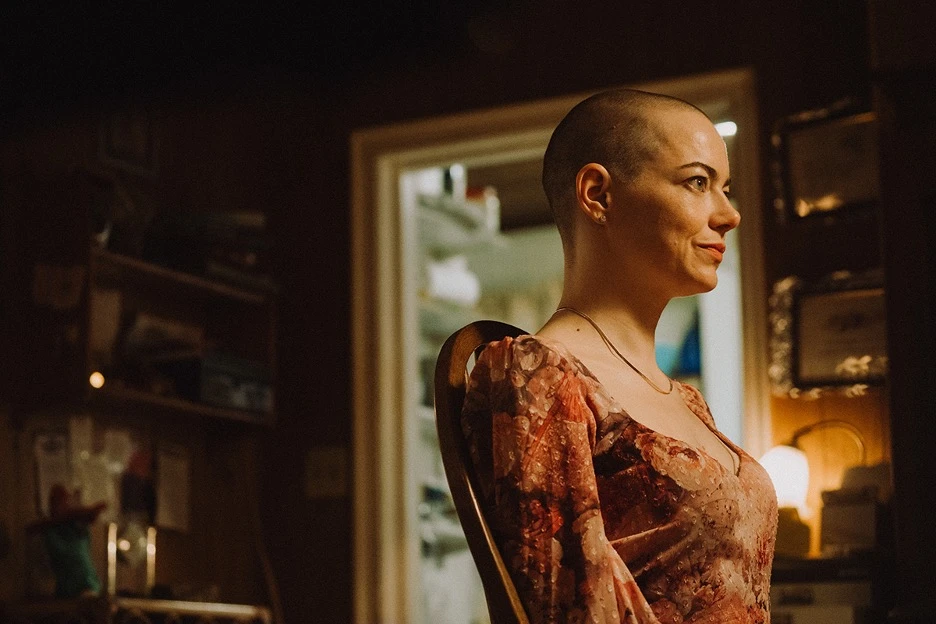
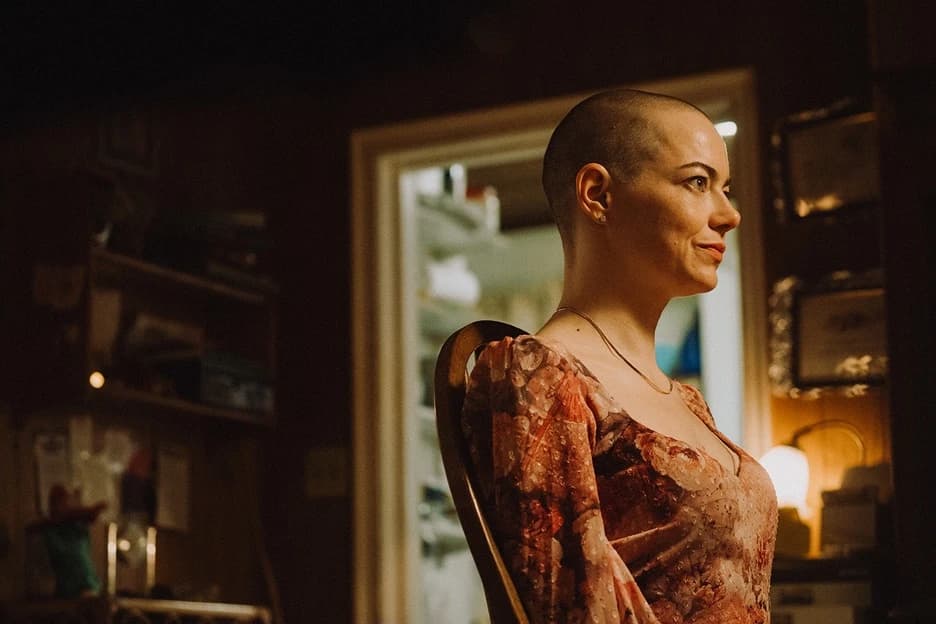
Emma Stone in Bugonia (2025), directed by Yorgos Lanthimos. Cinematography by Robbie Ryan. © Focus Features. Image courtesy of Universal Pictures.
Lanthimos’s Bugonia follows the story of the kidnapping of a Pharmaceutical Corporation CEO by two conspiracy theorists who believe that she is an alien using extraterrestrial technology to destroy humanity by polluting the Earth and decimating the population of bees. The film, unlike most sci-fi alien films, is gruesome in its exploration of extraterrestrial life and, in a way, creates an ambiguous perspective on the truth. Is Michelle Fuller really an alien? Or are Teddy and Don physically and mentally torturing a not-so-innocent human CEO? Lanthimos plays with the idea of beliefs in the film by never truly revealing the canonical truth until the film’s rather absurd yet comical twist ending. Lanthimos’s exploration of perceptual truth encourages the audience to reflect on what is real and what is myth, examining how perceptions of truth shape those who consume it.

Jesse Plemons in Bugonia (2025), directed by Yorgos Lanthimos. Cinematography by Robbie Ryan. © Focus Features. Image courtesy of Universal Pictures.
Plot, ambiguity and the psychology of belief
Bugonia guides the audience through Teddy’s conspiracies, only revealing their reality to them at the end of the movie. The conspiracies in themselves seem ridiculous: there was no way the Aliens who are apparently among us would plan to eliminate humanity by eliminating the bees. Through Teddy, Lanthimos showcases how the ordinary person can succumb to alternative beliefs, driven by feelings of disappointment in the world and a desire to find answers to causes that feel beyond one’s control. Researchers note that the broad scope of conspiracy theories offers consistent explanations that allow people to preserve their beliefs in the face of uncertainty and contradiction. It’s difficult to accept reality, and believing in an alternative often helps one process one's grievances. However, it doesn’t mean that believing in conspiracy theories is a healthy way to cope. Conspiracy beliefs increase deprivation of social needs. However, despite this, the believers are not just simple-minded, mentally unwell people, but also people who turn to said theories “to fulfill deprived motivational needs and make sense of distress and impairment.”
While conspiracy theories help people contextualize their beliefs, they will still feel forms of anxiety, as conspiracies in themselves are unlikely to make one feel safe or confident. Belief in conspiracy theories also often leads to social stigma, increasing the risk of social rejection. Despite the ‘comforting’ nature of denialist conspiracy theories, they serve only to explain the causation of current issues. For example, the belief that “Big Corporations are responsible for creating global issues.” However, it in turn can lead to beliefs that overexplain the causations of said anxiety of the global problems, like how “Michelle Fuller is responsible for humanity’s imminent demise because she is an alien overlord whose species wants to kill all of humanity by killing the bees.”

Emma Stone in Bugonia (2025), directed by Yorgos Lanthimos. Cinematography by Robbie Ryan. © Focus Features. Image courtesy of Universal Pictures.
Media, McLuhan and the echo chamber
As media conglomerates control the general public's point of view, we must consider big media’s role in funnelling folks into conspiracy theories. As Marshall McLuhan writes, “the effects of technology do not occur at the level of opinions or concepts, but alter sense ratios or patterns of perception steadily and without any resistance.” The more one consumes media that promotes certain ideologies, the more likely one is to believe them. Passive consumption of media, including mainstream and alternative media, can lead to the development of certain ideologies that shape one’s core beliefs, which explains why conspiracy theorists continue to consume theories and remain within their echo chamber of alternative truths. Added to their general distrust of controlled media, becomes the catalyst for their behaviour as a whole.
Michelle Fuller: performative humanism and corporate alienation
But is Michelle Fuller an Alien?
Spoiler alert, yes and no. The ending reveals Michelle is an alien, yes, but that the Andromedons are the earliest model for the current evolution of what we know as the ‘human’.
So, what is the truth?
The ‘truth’ behind Michelle Fuller’s human identity lies in perception. Emma Stone’s characterization of Michelle exemplifies performative humanism and corporate narrative control. Michelle controls the narrative around her, serving as a metaphorical ‘Queen Bee’ of her colony, wielding matriarchal-esque power over her employees who work tirelessly to aid her corporate ambitions without question. The consequences of her company’s endless ambitions are showcased through the suffering of Teddy’s mother, Sandy Gantz, lying in a vegetative state, thanks to Auxolith Corp’s miracle drug to cure Opioid Addiction. Her speech regarding Sandy Gantz’s condition is an excellent example of this human performance aided by corporate greed, as, according to Michelle, sacrifice is necessary to achieve success, delivered through a polished yet empty corporate PR apology that condescendingly thanks the Gantz family for their sacrifice.
The answer to the question of Michelle’s alien status, however, is up to manipulation as opposed to interpretation. Even in a state of grave danger, Michelle consistently ragebaits her captors, as she grows to see them as liabilities and unstable idiots who are wasting her time rather than the threat she initially saw them to be. Michelle’s shift in attitude shows how her status within the corporate power structure alienates her from the people she sees as beneath her. She perceives Teddy as an illogical, immoral and borderline idiotic man, so she uses his belief in conspiracy to guarantee her freedom. Michelle takes advantage of Teddy’s preposterous belief that she is an Andromedon Alien and manipulates him for her freedom by planting hints that the anti-freeze in her car will cure his mother. And Teddy, so deep in his echochamber of conspiracy, believes her, ultimately killing his mother in hospice care.
Cruelty, victims and the absurd ending
Bugonia’s showcase of human cruelty, presented through absurdist yet realistic storytelling, explores the extremes, examining human dread and misery and what they can lead to. In the end, the actual victims are neither Michelle, who was tortured and kidnapped, nor Teddy, whose beliefs in conspiracy led to his ultimate demise, but Sandy and Don, whose only grave sin is their optimistic beliefs that led to their respective downfalls. Lanthimos explores human cruelty in a similar film he did with Emma Stone, where Emma’s character, Bella Baxter, finds clarity after experiencing the true cruelties of class difference — you can read the whole piece at: Poor Things (2023): Exploring Human Nature, Feminine Agency and the Obsession with Power and Control.
The absurdity of the reveal that she is, in fact, an alien, and that all of Teddy’s conspiracies turned out to be true, is also, in a way, ambiguously true. The Audience is led to believe in Michelle’s human performance and understand that Teddy is crazy. But that is not the case, as the ending is absurd enough that audiences can either read it as the fact that they have been gaslit the entire time by Michelle and the Andromedons, or that the tonal shift is a metaphorical representation of how Michelle will never understand the struggles of the people she has hurt through her corporate experimentations even after experiencing one of her victims emotional and physical torture, making her the actual alien to society.
Bugonia’s service as a study of the relationship between corporations, conspiracy, and community offers a new, albeit dark, perspective on humanity. How existential dread can lead to dangerous extremities, how corporate irresponsibility in the name of development can facilitate conspiracy, and how one places importance on things that are often not worth fighting for. Lanthimos guides his audience to seek the truths hidden behind ideological conspiracies and narrative controls, perceiving the humanistic aspect of reality as a whole. Bugonia showcases truths in the eyes of its beholders, the narrative perceptions that lead to destruction and how everyone is vulnerable to the clutches of conspiracy, especially in an environment that values the strong.
Works Cited
Bennington-Castro, J. (2025, November 4). What is the ancient ritual of Bugonia? HISTORY.
Fadel, L. (2025, October 24). Conspiracy theorists fuel “Bugonia” climate horror. NPR.
Index of US Mainstream Media Ownership | The Future of Media Project. (n.d.).
Li, S. (2025, November 10). ‘Bugonia’: An Intimate Portrait of Humanity at Its Worst. The Atlantic.
Logo IMPERIUM ROMANUM. (2001, November 25). IMPERIUM ROMANUM.
McLuhan, M. (1964). Understanding Media: The Extensions of Man. McGraw-Hill Companies.
‘The Bees (Virgil’s Georgics: Book IV)’ | TLS. (2016, September 6). TLS.